
-
 info@arablabels.com
- October 20, 2026
- No Comments

In modern warehouses and manufacturing facilities, choosing the right identification technology can have a direct impact on inventory accuracy, labour efficiency, traceability and operational visibility. Barcode Labels UAE solutions remain a practical and widely used option for checkpoint-based processes, while RFID can provide faster, automated identification where high-volume tracking is required.
The decision, however, is not simply about choosing one technology over the other. In many UAE operations, the strongest approach is a hybrid barcode and RFID system, where each technology is used where it delivers the most value. Barcode and RFID can operate as a connected identification layer within modern warehouse management systems, with GS1 identifiers providing a common foundation.
Barcode vs RFID: What Is the Difference?
Barcode systems use printed symbols that are captured through optical scanning, while RFID uses radio-frequency signals to identify tagged items. This creates an important difference in how information is captured.
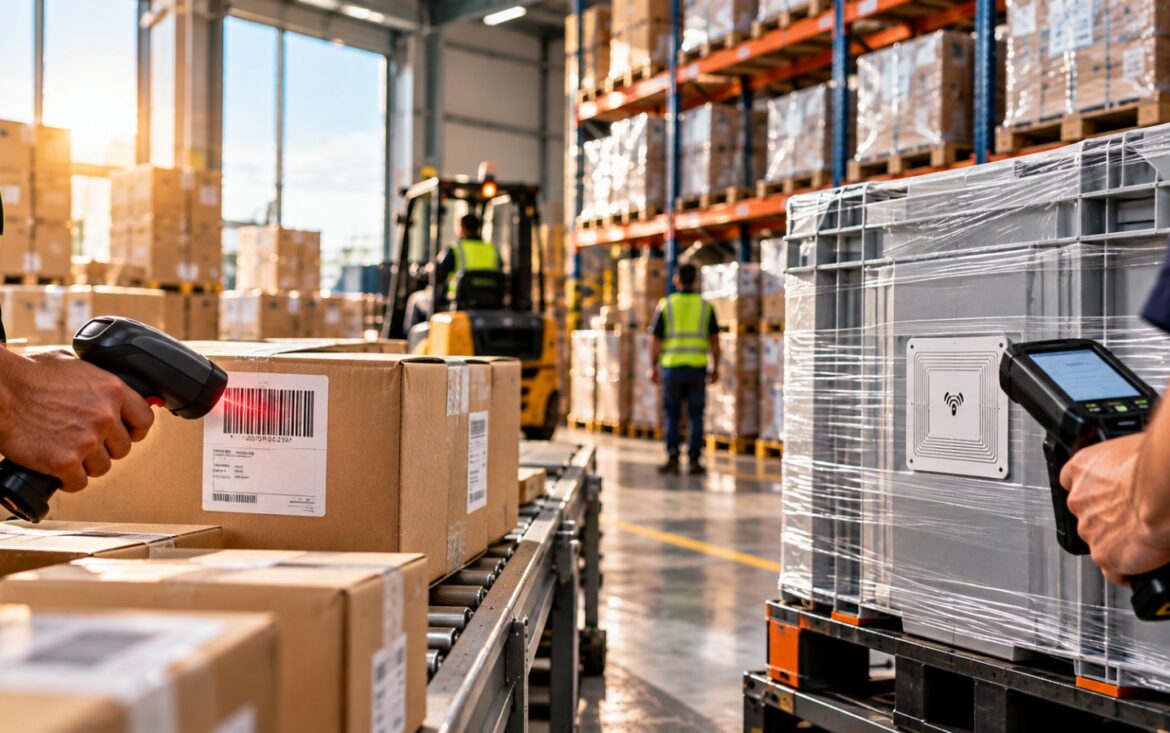
A barcode normally requires line of sight and is generally scanned one item at a time. RFID does not require direct visibility and can read multiple tagged items within a suitable range. Passive UHF RFID can therefore be particularly useful for bulk identification at receiving docks, conveyor points and inventory-counting areas.
Barcodes, meanwhile, remain attractive because they are relatively simple to deploy, cost-effective and well suited to processes where an employee deliberately verifies an individual item.
When Barcode Labels Make More Sense
For many warehouses and manufacturing environments, barcode identification is still the most practical starting point.
Barcode labels work particularly well when:
- Employees need to verify individual items.
- Picking and packing require deliberate confirmation.
- Products already carry printed identification.
- Budgets favour lower infrastructure costs.
- The operating environment contains significant amounts of metal or liquid.
- Existing WMS or ERP systems already support barcode workflows.
For example, during picking, an operator can scan the product and location barcode before confirming the transaction. This provides a clear verification point without requiring RFID infrastructure.
For businesses looking for Barcode Labels UAE solutions, the label itself also matters. Material, print quality, adhesive performance and barcode contrast can influence scanning reliability, particularly in warehouses exposed to dust, heat, moisture or frequent handling.
When RFID Becomes the Better Choice
RFID becomes more compelling when the operation needs to identify large quantities of items quickly or reduce the amount of manual scanning.
Typical applications include:
High-Volume Receiving
An RFID portal can capture multiple tagged items as they pass through a dock area, reducing the need to scan every carton individually.
Faster Inventory Counting
Instead of scanning each item sequentially, RFID enables bulk reading of tagged inventory. This can significantly reduce the time and labour associated with cycle counts. The supplied technical material identifies RFID-assisted cycle counting as particularly useful for high-volume warehouse environments.
Asset and WIP Tracking
Manufacturers can use RFID to track tools, fixtures, containers and work-in-progress through different production stages. This becomes valuable when knowing the current status or movement of an item is more important than simply recording a transaction at a checkpoint.
Automated Dispatch Verification
RFID can also support outbound portals that automatically verify tagged cartons or pallets against a shipment, helping identify mismatches before goods leave the facility.
Where RFID Has Limitations
RFID is not automatically the right solution for every warehouse.
Metal and liquids can interfere with UHF RFID performance, while dense storage environments can create challenging RF conditions. Appropriate tag selection and site testing are therefore essential.
This is especially relevant in UAE manufacturing and logistics facilities where metal racking, industrial equipment, packaged liquids and other RF-sensitive materials may be present.
Barcodes can sometimes be the more reliable choice in these situations because the operator directly scans the printed identification.
There is also a larger implementation requirement. RFID may require readers, antennas, middleware, WMS/MES integration and an RF site survey. Barcode systems generally have a simpler infrastructure requirement.
The UAE Warehouse Context
The UAE’s position as a major logistics and distribution hub makes identification technology increasingly important. Dubai, Abu Dhabi and Sharjah support large warehouse, manufacturing and distribution operations where faster processing and better inventory visibility can create measurable operational advantages.
The technical source notes that UAE warehouses are increasingly adopting RFID-enabled smart warehousing alongside automation technologies such as robotics and AGVs, while GS1 barcode standards remain fundamental to many applications.
Regulatory requirements also influence the decision. In pharmaceuticals, for example, GS1-compliant 2D DataMatrix barcodes remain a critical part of product identification and traceability. RFID may complement warehouse automation, but it does not simply eliminate the need for compliant barcode identification.
For UAE businesses, this means technology selection should begin with process requirements and compliance obligations, not with the technology itself.
Why Hybrid Barcode & RFID Systems Can Be Practical
In many real-world operations, there is no need to replace barcode systems completely.
A hybrid approach can assign different roles to each technology:
Barcode:
Product identification, rack locations, picking, packing and manual verification.
RFID:
Bulk receiving, automated portals, cycle counting, asset tracking and high-volume movement.
For example, an inbound dock could use RFID to identify a complete tagged pallet quickly, while barcode labels remain available for individual carton verification and rack-location scanning.
This approach can also protect existing investments in printers, scanners and Barcode Labels UAE infrastructure while introducing RFID only where automation delivers measurable benefits.
Consider Total Cost, Not Just Hardware Price
A common mistake is comparing the price of a barcode label with the price of an RFID tag and making the decision from there.
The real calculation should include:
- Labels or RFID tags
- Printers and scanners
- RFID readers and antennas
- Software and middleware
- WMS/ERP/MES integration
- Site engineering
- Training
- Maintenance
- Labour savings
- Reduction in inventory errors
- Reduction in shipping mistakes
- Asset-loss reduction
Barcode systems generally have a lower initial infrastructure requirement, while RFID requires greater investment but can reduce repetitive manual identification work.
Label Printing Automation: The Next Step in Warehouse Efficiency
Technology selection should also consider how identification data is created and maintained. Label printing automation can connect barcode generation more closely with WMS or ERP workflows, reducing manual data entry and helping maintain consistency across product, carton, pallet and location labels.
For operations that are not yet ready for RFID, improving barcode printing, verification and scanning can be a practical first step toward greater automation. Businesses can then introduce RFID selectively as volumes, automation requirements and ROI justify the investment.
Final Thoughts
There is no universal winner in the barcode-versus-RFID debate. Barcode Labels UAE solutions remain highly effective for individual verification, picking, packing, location identification and compliance-driven applications. RFID becomes more valuable when businesses need bulk reading, automated checkpoints, faster inventory counts or greater visibility across high-volume workflows.
For many UAE warehouses and manufacturing facilities, the most practical strategy is to combine both technologies rather than replace one with the other.
Start by identifying the bottleneck, quantify the cost of the existing process, consider the operating environment and regulatory requirements, and test the proposed solution in a controlled area before scaling. With the right approach, label printing automation, barcode identification and RFID can work together to create a more accurate, connected and efficient operation.